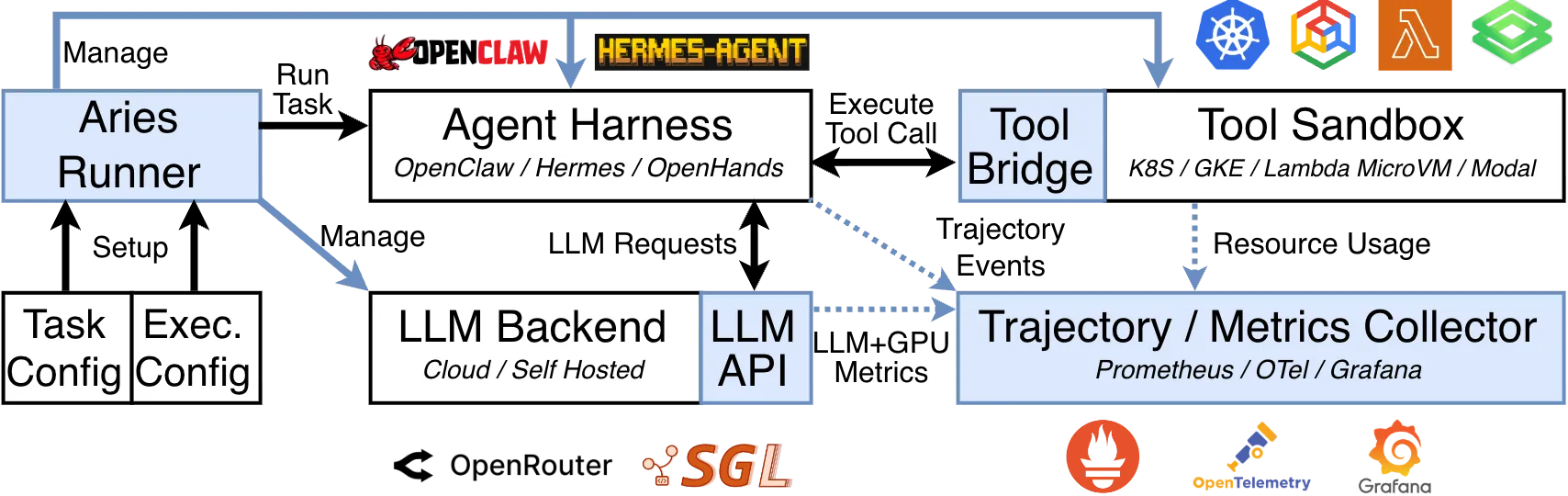
ARIES is an open-source experimentation framework for agent serving systems. It lets systems researchers run reproducible agent benchmarks while observing the full task trajectory: repeated model calls, harness decisions, stateful tool execution, task outcome, and resource telemetry.
Agent workloads are not isolated LLM requests. An agent repeatedly observes its state, invokes a model, executes tools in a sandbox, and incorporates the results into the next step. ARIES treats that end-to-end trajectory as the unit of experimentation, so researchers can relate task progress and correctness to behavior across the agent-serving stack.
Why ARIES
- Preserve task semantics across configurations. Benchmark tasks and their evaluation stay separate from the chosen harness, model backend, tool bridge, sandbox and telemetry setup.
- Observe complete agent trajectories. Run artifacts and correlated evidence show where an agent spends time and how execution behavior relates to the final outcome.
- Make stateful tool execution comparable. A narrow bridge gives the harness temporary access to a persistent task environment, while sandbox adapters keep control of lifecycle, isolation and resource observation.
- Ground systems research in production behavior. ARIES ships the Ant Group Agentic LLM Trace 2026, with engine request logs and harness-environment metrics from a real online serving workload.
What it supports today
| Role | Implementation |
|---|---|
| Agent harness | OpenClaw (text and realtime voice), Hermes (text) |
| Benchmark | Terminal-Bench 2, Deep Research Bench, SWE-bench Pro (public split) |
| Tool sandbox | Docker |
| Model service | DeepSeek, OpenAI-compatible servers such as vLLM, SGLang |
ARIES is built and maintained in collaboration with Amazon Web Services, Microsoft, AMD Singapore, Ant Group and NCSpeech. See the roadmap.